Immenstaad, June 21, 2023 – Aircraft seats rarely stay in a cabin for more than eight to ten years. Raffael Rogg, Managing Director of ZIM Aircraft Seating GmbH, on eco-design, take-back and refurbishment – and on why the life cycle of a seat is decided long before the first drawing.
Sustainability is created in design, not in disposal
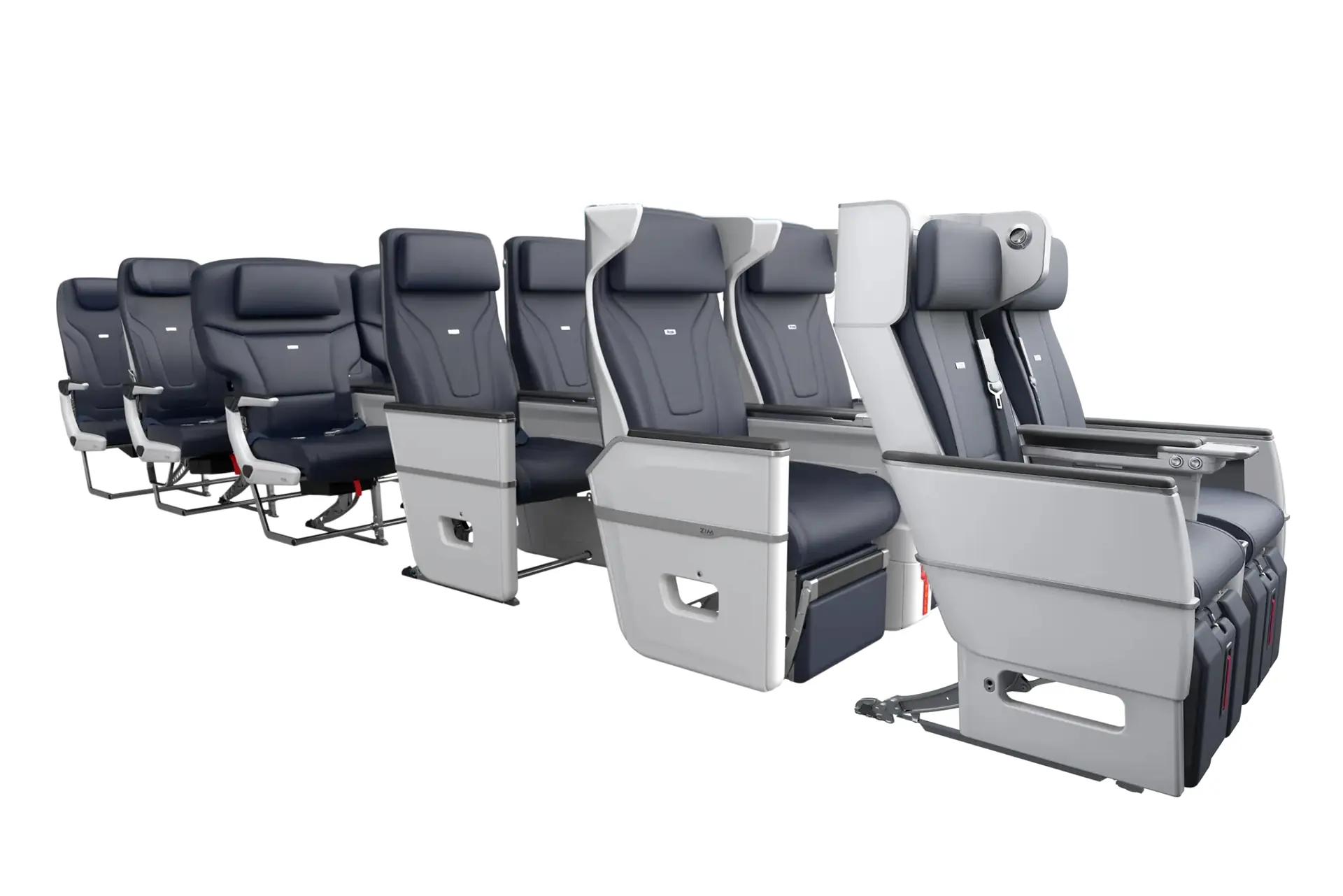
We think through every phase of the product life cycle before a development begins – as a design requirement, not an attitude: mono-materials instead of composites that are hard to separate, a modular architecture instead of integral components, screws instead of adhesives. Each of these decisions makes later disassembly and material separation easier. The framework for this is our EMAS environmental management system.
Materials that can be separated again at the end
This is most evident in the cushions: as an alternative to the foam cushion, we are developing a mesh-structure fabric, comparable to a trampoline. A component like that can be returned to a single-material stream after use, whereas bonded foam-and-cover composites effectively end up as waste. Precisely this question – what happens to the component at the end? – belongs in the design specification for us, not in the sustainability report.
Take-back, refurbishment, second life
A seat does not reach the end of its life when an airline removes it: after eight to ten years in the cabin it is replaced, but technically it is far from worn out. We take these seats back free of charge, refurbish them, adapt covers and modules to the requirements of smaller airlines and return them to service – there are airlines that deliberately prefer refurbished seats. In this way a seat gets a second, sometimes a third life. It is only finally disposed of when it is too heavy compared with the next generation of used seats.
Take-back has become a value chain in its own right – the decisive difference from a sustainability initiative: it is self-sustaining commercially. Sustainable design makes the seat more expensive to buy; over its service life, however, operating costs and CO₂ emissions matter more to an airline.
Reference Austrian Airlines: cabins are expanded, not replaced
How robust this approach is can be seen in the Premium Economy expansion at Austrian Airlines: the airline has enlarged the class across its long-haul fleet in several steps and is deploying the ZP610 in the process. The program draws on an established, certified seat platform – the existing cabin is expanded rather than replaced. That is exactly why it pays to keep a product maintainable and reproducible over many years.
Conclusion
A seat does not become sustainable at the end of its use, but in the design phase. For us, circularity is therefore not a chapter in a sustainability report but part of product development.